
• Skip to main content
  • Skip to header right navigation
  • Skip to site footer

Due to the lapse in federal government funding, NASA is not updating this website.

NASA classic meatball logo with the text Goddard Engineering and Technology Directorate.

Goddard Engineering and Technology Directorate

  • About ETD
    • About ETD
    • Key Personnel
    • Images
    • Multimedia
    • Featured Stories
  • Capabilities
    • ETD Capabilities
    • Capabilities Listing
    • Facilities Listing
    • core Flight System
    • Flight Dynamics Facility
    • Integrated Design Center
    • In-Space Servicing, Assembly, and Manufacturing
  • Partnerships
  • Our Work
  • Divisions
    • Wallops Engineering
    • Aerospace Flight Hardware & Technology
    • Systems Architectures
  • Careers
    • Internships

Uncovering Dark Energy’s Biggest Secrets
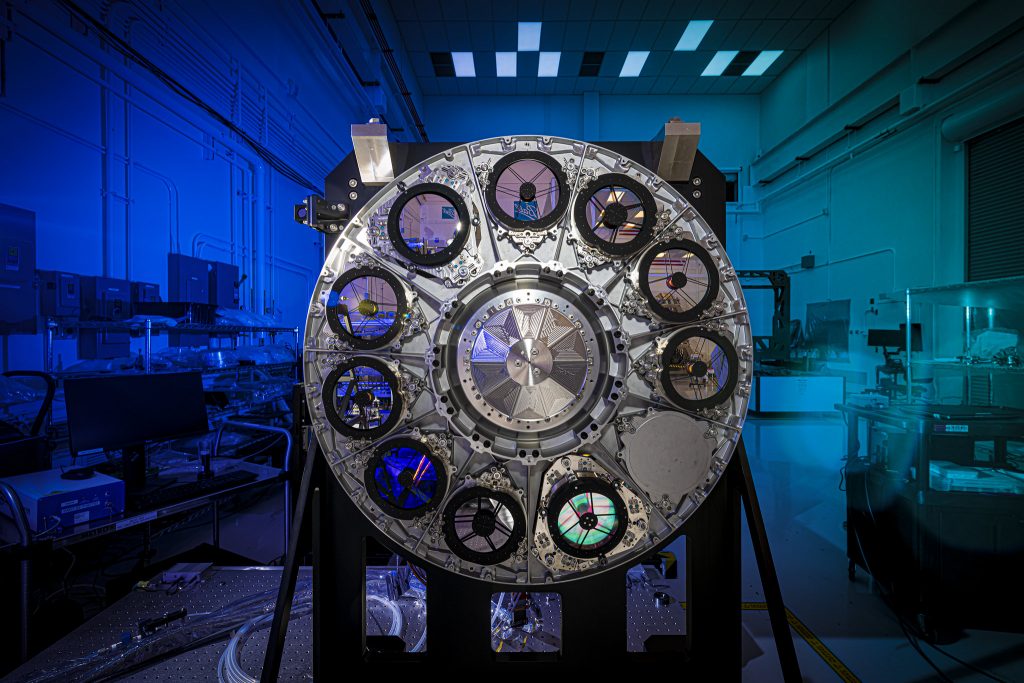
A colorful image of the Nancy Grace Roman Space Telescope's element assembly wheel.
The element assembly wheel of the Nancy Grace Roman Space Telescope. Credit: NASA

Illuminating the Dark

The Nancy Grace Roman Space Telescope (Roman) is an infrared telescope named after Nancy Grace Roman that seeks to explore the mysteries of dark energy and image exoplanets. Roman and the James Webb Space Telescope offer broader ranges of sight when compared to the Hubble Space Telescope and are steps NASA and Goddard Space Flight Center are taking to uncover the secrets of space. The ISTD has contributed to Roman through the PRISM and GRISM optics where the GRISM is used for a broad sky survey for dark energy, and then the PRISM is used for looking at supernova/dark energy. The GRISM will be used to measure red shifts of large areas of the sky of galaxies and to help figure out how fast they’re moving away. As we know, the universe has been expanding since The Big Bang, but everyone thought that it would start slowing down. These instruments will kind of gauge that expansion curve when things moved away.

Because of Roman’s large field of view and the size of the focal plane, these optics (PRISM and GRISM) are large, being four or five inches in diameter. They’re multiple elements instead of just like a wedge of glass with multiple glasses put together, so they had to mount both of these instruments and co-align their optics while using unique glass materials to get all the properties. Contrary to popular belief, the universe’s expansion has started accelerating due to a force called dark energy instead of slowing down. NASA is working to uncover the secrets of the universe by digging into a deeper understanding of dark energy.

ABOUT ETD

The Engineering and Technology Directorate at NASA Goddard designs, builds, and develops space flight technology for American leadership in space. The technical workforce brings this expertise to NASA’s portfolio and supports mission partnerships across the whole of government and industry.

Learn More

NASA.gov

NASA Goddard

News & Events

NASA+

EXPLORE ETD

Key Personnel

Featured Stories

Internships

FOLLOW

  • X
  • Facebook
  • Flickr
  • YouTube
  • Instagram

More NASA Social Accounts


NASA classic meatball logo.

Page Last Updated: Feb 10, 2025

Page Editor: ETD Web Team

Responsible NASA Official: Hector Dietsch

Sitemap

FOIA

Privacy

Accessibility

Contact ETD