
• Skip to main content
  • Skip to header right navigation
  • Skip to after header navigation
  • Skip to site footer

Due to the lapse in federal government funding, NASA is not updating this website.

NASA classic meatball logo with the text Goddard Engineering and Technology Directorate.

Goddard Engineering and Technology Directorate

  • About ETD
    • About ETD
    • Key Personnel
    • Images
    • Multimedia
    • Featured Stories
  • Capabilities
    • ETD Capabilities
    • Capabilities Listing
    • Facilities Listing
    • core Flight System
    • Flight Dynamics Facility
    • Integrated Design Center
    • In-Space Servicing, Assembly, and Manufacturing
  • Partnerships
  • Our Work
  • Divisions
    • Wallops Engineering Office (WEO)
      • WEO Branches
    • Mechanical Systems Division (MSD)
      • MSD Branches
    • Instrument Systems & Technology Division (ISTD)
      • ISTD Branches
    • Electrical Engineering Division (EED)
      • EED Branches
    • Software Engineering Division (SED)
      • SED Branches
    • Mission Engineering & System Analysis (MESA)
      • MESA Branches
  • Careers
    • Internships

  • Capabilities
  • Capabilities Home
  • Capabilities Listing
  • Facilities Listing
  • Contact ETD

Acoustic Test Facility
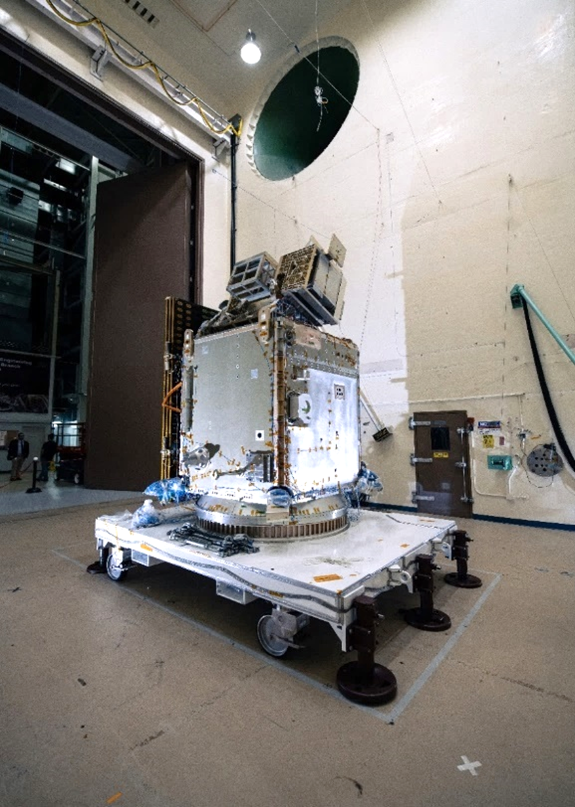
Plankton, Aerosol, Cloud, ocean Ecosystem (PACE) Structural Verification Unit (SVU) in the Acoustic Facility.

Preparing for the Roar of Launches

The Acoustic Test Facility at the Goddard Space Flight Center (GSFC) is designed to subject a wide range of scientific satellites, subsystems, and spaceflight components to the intense acoustic loads experienced during launch. The facility includes a reverberant chamber, acoustic horns, noise generators, a control console, and a data acquisition system.

The reverberant chamber, which provides a uniform simulated acoustic environment, has internal dimensions of 33 feet in length, 27 feet in width, and 42 feet in height. Payloads are introduced through a 15-foot wide by 30-foot high access door and are either suspended from a crane or mounted on a specialized fixture in the center of the chamber.

When required, the chamber can be converted into a Class 100,000 cleanroom after the payload access doors are closed and the facility is cleaned. A forced ventilation system helps stabilize chamber pressure during test operations and purges the chamber with gaseous nitrogen (GN2) to ensure safe entry after the test.

Engineers use a closed-loop controller to regulate the flow of GN2 through noise generators attached to each of the two horns, generating the necessary level of acoustic energy. The facility can produce a maximum overall sound pressure level (OASPL) of 150 dB. Acoustic tests typically last between 60 and 120 seconds.

These tests ensure that spacecraft can withstand the acoustic environment of launch and provide accelerometer data for validating and refining structural analysis models. The Acoustic Test Facility has been used to test flight hardware for GSFC in-house projects, other NASA missions, and private industry.


The Acoustic Facility is managed by ETD’s Mechanical Systems Division (MSD). Contact MSD for more information.


ABOUT ETD

The Engineering and Technology Directorate at NASA Goddard designs, builds, and develops space flight technology for American leadership in space. The technical workforce brings this expertise to NASA’s portfolio and supports mission partnerships across the whole of government and industry.

About ETD’s Mission

NASA.gov

NASA Goddard

News & Events

NASA+

EXPLORE ETD

Key Personnel

Featured Stories

Internships

EMPLOYEES

ETD Internal

ETD Town Hall

FOLLOW

  • X
  • Facebook
  • Flickr
  • YouTube
  • Instagram

More NASA Social Accounts


NASA classic meatball logo.

Page Last Updated: Jul 10, 2025

Page Editor: ETD Web Team

Responsible NASA Official: Hector Dietsch

Sitemap

FOIA

Privacy

Accessibility

Contact ETD