
• Skip to main content
  • Skip to header right navigation
  • Skip to after header navigation
  • Skip to site footer

Due to the lapse in federal government funding, NASA is not updating this website.

NASA classic meatball logo with the text Goddard Engineering and Technology Directorate.

Goddard Engineering and Technology Directorate

  • About ETD
    • About ETD
    • Key Personnel
    • Images
    • Multimedia
    • Featured Stories
  • Capabilities
    • ETD Capabilities
    • Capabilities Listing
    • Facilities Listing
    • core Flight System
    • Flight Dynamics Facility
    • Integrated Design Center
    • In-Space Servicing, Assembly, and Manufacturing
  • Partnerships
  • Our Work
  • Divisions
    • Wallops Engineering Office (WEO)
      • WEO Branches
    • Mechanical Systems Division (MSD)
      • MSD Branches
    • Instrument Systems & Technology Division (ISTD)
      • ISTD Branches
    • Electrical Engineering Division (EED)
      • EED Branches
    • Software Engineering Division (SED)
      • SED Branches
    • Mission Engineering & System Analysis (MESA)
      • MESA Branches
  • Careers
    • Internships

  • Capabilities
  • Capabilities Home
  • Capabilities Listing
  • Facilities Listing
  • Contact ETD

Space Environment Simulator
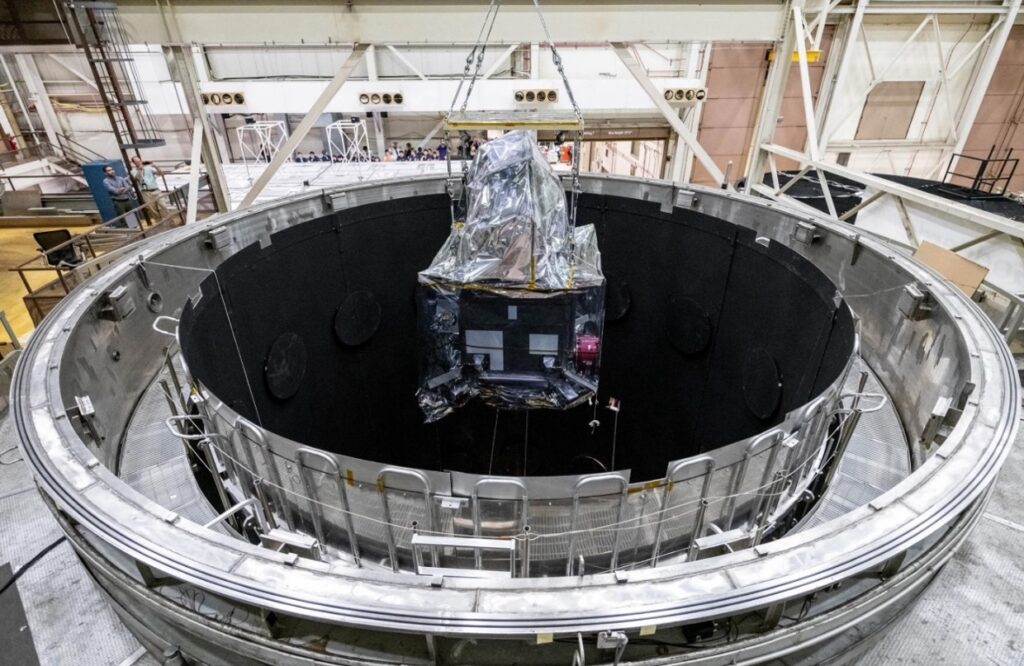
PACE spacecraft being loaded into the Space Environment Simulator

Simulating the Vacuum and Temperature Extremes of Space

The Space Environment Simulator at Goddard Space Flight Center is a large, vertically oriented thermal vacuum chamber with an internal test volume of 27’ in diameter and 40’ in height.  The chamber dome is rolled back to allow for test articles to be lifted into the chamber from the main floor via crane, while chamber entry for personnel is located in the basement.

Initial pumpdown is achieved with a mechanical pumping system consisting of eight rotary piston pumps with Roots blowers and can bring the chamber pressure below 100 microns (0.1 Torr).  Once the initial pumpdown is complete, the high vacuum pumping system, consisting of 8 cryopumps and a turbomolecular pump, can bring the chamber pressure below 1 x 10⁻⁶ Torr.

The chamber shroud, and optionally the payload table, can be operated between -80° and +80° C and can also be flooded with liquid nitrogen to bring temperatures below -190° C.  A helium refrigeration system can be used for cooling a secondary internal shroud or cryopanels to 20° K.  Support for up to seven additional cryocircuits with either liquid nitrogen or gaseous nitrogen at temperatures between -150° and +150° C is also available, as well as support for over 150 heater circuits.

The data system includes over 1,000 thermocouple channels and records data every minute.  A Residual Gas Analyzer and Thermoelectric Quartz Crystal Microbalance are used for contamination monitoring purposes.  Additional capabilities can be provided in consultation with a Space Simulation Test Engineer.


The Space Environment Simulator is managed by ETD’s The Mechanical Systems Division (MSD). Contact MSD for more information.


ABOUT ETD

The Engineering and Technology Directorate at NASA Goddard designs, builds, and develops space flight technology for American leadership in space. The technical workforce brings this expertise to NASA’s portfolio and supports mission partnerships across the whole of government and industry.

About ETD’s Mission

NASA.gov

NASA Goddard

News & Events

NASA+

EXPLORE ETD

Key Personnel

Featured Stories

Internships

EMPLOYEES

ETD Internal

ETD Town Hall

FOLLOW

  • X
  • Facebook
  • Flickr
  • YouTube
  • Instagram

More NASA Social Accounts


NASA classic meatball logo.

Page Last Updated: Jul 10, 2025

Page Editor: ETD Web Team

Responsible NASA Official: Hector Dietsch

Sitemap

FOIA

Privacy

Accessibility

Contact ETD