
Aerospace Flight Hardware & Technology
The Aerospace Flight Hardware & Technology Division (AFHT) provides comprehensive technical leadership for the full life cycle development of advanced instrumentation and aerospace flight systems for NASA’s Earth and Space missions. As an innovative center of multidisciplinary hardware expertise, the AFHT delivers end-to-end capabilities spanning instrument development, flight electrical/electronic systems, and mechanical/thermal systems to enable state-of-the-art ground-based, suborbital, orbital and exploration missions.
Core Capabilities
The AFHT provides engineering leadership and support across three integrated technology domains:
- Instrument Systems and Technologies: Development of innovative measurement concepts and techniques, advanced instrument concepts, scientific instrument proposal support, system definition, analysis, and implementation. Capabilities include active and passive instrument systems covering the full electromagnetic spectrum, detector systems and focal plane technologies, optical design and analysis, cryogenic and fluid systems, laser and electro-optical sensors, and microwave instrument technologies.
- Electrical and Electronic Systems: Expert leadership in flight avionics systems and architectures, including electronics parts and radiation effects, extreme environment microelectronics, analog and digital signal processing, command and data handling, electrical power processing, communications and tracking, electromagnetic interference effects, harnessing, integration and test, and electrical ground support equipment.
- Mechanical and Thermal Systems: Multidisciplinary capabilities for materials and processes qualification, mechanical design and structural analysis, thermal control systems, contamination analysis and protection, electromechanical devices for precision applications, deployable structures, and comprehensive manufacturing, assembly, integration, and testing support.
Mission Support
The AFHT collaborates closely with stakeholders and customers to identify emerging technology requirements and support proposal development, conceptual designs, and mission implementation. The Division provides leadership in developing and implementing technology programs aimed at reducing mission costs, enhancing performance, and simplifying design and development processes.
Facilities and Operations
The AFHT operates and maintains comprehensive laboratory facilities and specialized capabilities for design, development, manufacture, assembly, integration, calibration, environmental simulation, and testing of space flight hardware systems and subsystems, and ground support equipment. The Division provides simulations and assessments of structural and electrical integrity, functional performance, and safety throughout all mission phases.
Technology Development and Partnerships
The AFHT advances state-of-the-art technologies through active research and development programs, ground-based and flight experiments, and technology demonstration activities. The Division maintains strong partnerships and collaborations with other NASA Centers, government agencies, national laboratories, universities, and industry to leverage resources and advance technology infusion. Technology transfer and commercialization programs ensure broad utilization of developed capabilities.
Integration and Leadership
The AFHT coordinates multidisciplinary teams and works in close cooperation with other GSFC organizations and integrated product teams. The Division provides technical oversight, evaluation, consultation, and support to flight project teams, design review teams, and technical evaluation panels across NASA, government agencies, industry, and universities. The AFHT sustains active educational outreach programs to develop partnerships and engage diverse student communities in advanced technology development activities.

Credit: NASA
Integrated Detector & Electronic Systems
The Integrated Detector & Electronic Systems Branch provides radiation detector, front-end electronics, and microwave technology expertise to enable the end-to-end conceptualization and development of systems for Earth and Space missions.
Provides expert leadership to design, develop, test, and deliver radiation detectors for all regions of the electromagnetic spectrum and microwave systems and electronics systems for space flight science applications including front-end electronics, analog signal filtering and conditioning, temperature control electronics, analog-to-digital conversion, digital signal processing, and science data processing. Develops analog and digital electronics to control various sensors and actuators.
Formulates detector electronic systems architectures for conceptual studies and proposals on new and future systems. In collaboration with stakeholders, develops these concepts and designs, and builds prototypes and development units for laboratory demonstration. For flight projects, designs and develops engineering and flight units, performs verification testing, and delivers detector electronic systems to flight projects for integration.
Provides and maintains facilities, laboratories, analytic tools, and expertise in the areas of advanced detectors, detector-specific electronics, custom semiconductor devices, and microwave technology developments.
Provides expert personnel and maintains specialized tools and laboratories in the design, analysis, and test of advanced microelectronics devices, such as: mixed-signal application specific integrated circuits (ASICs) and field programmable gate arrays (FPGAs).

Optics, Lasers & Photonics
The Optics, Lasers & Photonics Branch provides comprehensive engineering and technology expertise to enable end-to-end conceptualization and development of optical, laser and electro-optical systems for Earth and Space missions.
Supports the design, development, testing, and flight of optical and laser systems across all mission phases, from pre-phase A research to flight program support, while proactively transferring technology to the private sector.
Provides and maintains facilities, laboratories, analytic tools, and technical expertise in: optical system design/analysis, optical component development/test, optical materials/thin films, optical system assembly/alignment/test, opto-mechanical design/analysis, lidar systems, lidar detector technology, solid state laser transmitters, tunable lasers, image stabilization/pointing, non-linear optics technologies, and photonic integrated circuits (PIC) including design, qualification, assembly, and failure analysis.
Provides technology leadership by conceiving, planning, implementing, and conducting in-house or external technology programs that enhance core capabilities for future Space and Earth missions. Partners with industry, universities, other government laboratories and NASA Centers to enable external technology programs.

Thermal Engineering, Cryogenics & Fluids
The Thermal, Cryogenics & Fluids Branch provides engineering expertise in thermal control systems, cryogenic/fluid systems, and spacecraft propulsion subsystems for spaceflight applications including spacecraft, instruments, experiments, sensors, technology development and related systems. The branch conceives, develops, and reviews thermal design and associated elements, provides cryogenic and fluid system expertise to development teams, study teams, and proposal teams to enable the end-to-end conceptualization and development of space systems, and provides engineering expertise in spacecraft propulsion subsystem design, analysis, fabrication, assembly, integration, test, and launch and post-launch operations, including spacecraft propellant loading.
The branch develops advanced thermal hardware, thermal technology, and state-of-the-art aerospace cryogenic cooling systems for future applications including heat pipes, two-phase heat transfer systems, high conductivity materials, heat pumps, liquid helium systems, sub-Kelvin coolers, and hybrid cooling systems. It defines next generation propulsion technology requirements and analyzes, develops, tests, and integrates advanced propulsion system technologies. The branch designs, analyses, develops, tests, and evaluates specialized fluid systems, leads the NASA effort to develop long life cryogenic coolers, and specifies, procures, and tests propulsion components to meet mission and/or advanced technology requirements. It engineers the design, development, and operation of flight experiments to verify thermal control technology and to investigate micro-gravity effects on performance.
The Thermal, Cryogenics & Fluids Branch develops, operates, and maintains unique test facilities for testing specialized thermal control devices and components, cryogenic systems and components, including cryogenic cooler test beds with advanced measurement capabilities. The branch operates the Propulsion Test Site to evaluate propulsion and fluid components, including providing precision cleaning of plumbing and providing residual gas analyses. It develops, operates, and maintains thermal vacuum test facilities for space environment simulation to perform technology maturation, flight component qualification and characterization tests of thermal control hardware, and provides engineering management, procurement technical support, performance evaluation, and anomaly assessment of flight projects for spacecraft propulsion subsystems and expendable launch vehicle propulsion systems.
The branch develops and maintains advanced thermal analysis tools, including graphics capability for thermal engineering, and develops and maintains databases of thermal property and test data. It conducts performance evaluation of sub-orbital class launch vehicle propulsion systems and provides chemical analyses and test in support of propulsion related efforts. The branch develops and maintains expertise in discrete thermal technologies such as radiative cooler design and thermal analysis, cryogenic temperature thermal design and analysis, and continuum aerodynamic heating, and develops and maintains guidelines for thermal design and analysis, including thermal vacuum test requirements.
The Thermal, Cryogenics & Fluids Branch provides support for tests, launch, and mission operations, and plans and coordinates thermal vacuum tests for performance verification and environmental qualification of flight components. It serves as part of mission control teams during launch and early checkout to ensure that thermal requirements are met and that thermal control systems are working properly and collaborates with GN&C customers and stakeholders to assure effective interchange of information and coordination of propulsion technology programs. The branch supports the design, development, testing, and flight of cryogenic systems through teaming with scientists and technologists in all stages of development, from pre-phase A research through to supporting flight programs.
The branch collaborates with engineering organizations, directorates, and external partners, collaborators and customers to provide appropriate technology-enabling activities and proactively works to transfer technology to the private sector, as well as foster broad community outreach. It supports project teams, experimenters, managers, technical review teams, failure analysis teams, Technical Advisory Committees, and Source Evaluation Boards. The branch conducts conceptual and feasibility studies that include system level performance, cost, and schedule issues, provides technical oversight, evaluation, consultation, and review of projects and contract proposals, and initiates and develops new hardware and software to meet advanced requirements.
Avionics, Navigation & Communications Electronics
The Avionics, Navigation & Communications Electronics Branch provides comprehensive expertise in the design, development, test, and delivery of spaceflight electronics systems across multiple integrated domains. All branch capabilities are unified by their focus on spaceflight electronics applications, from conceptual design through end-of-life operations.
Communications & RF Systems: The Branch leads development of advanced RF and optical communication technologies for near-earth, lunar, and planetary missions. Capabilities include communication system components (antennas, receivers, radiometers, power amplifiers, transponders, transceivers), coding and compression technologies, and next-generation terminals. The Branch provides Product Development Leads for RF communications subsystems, develops Ground Support Equipment for Integration and Testing, and maintains expertise in space and ground networks engineering, microwave sensing instruments, and mission operations communications.
Power Systems: The Branch delivers electrical power generation, conversion, management, distribution, and processing for space applications. This includes electrochemical expertise for flight batteries and advanced energy storage, photovoltaic engineering for solar cell arrays and solar-electric conversion systems, and power electronics for efficient voltage regulation and conversion serving science instruments, payloads, and spacecraft.
Avionics & Data Systems: The Branch provides systems-level leadership in avionics architectures, interface compatibility, electrical harnessing, advanced networks, and electrical ground support equipment. Core capabilities include command and data handling subsystem engineering, flight data systems development, high performance space computing electronics, radiation-hardened microprocessors, data processing electronics, bulk data storage, attitude control electronics, and electromagnetic interference/compatibility solutions.
Autonomous Navigation & Control: The Branch develops advanced Guidance, Navigation & Control component technologies including sensors, actuators, propulsive devices, and their interfaces, with emphasis on electronics for autonomous navigation systems, hybrid dynamic simulators, and component test facilities for validation. The Branch designs electronic control systems for electromechanical actuators, develops mathematical models and simulation studies of control systems, and provides sensors, actuators, and control electronics with spacecraft interface compatibility.
Integrated Capabilities: The Branch maintains specialized fabrication, assembly, and rework capabilities for spaceflight electronics, operates component test facilities and validation systems, and collaborates with industry, academia, and national laboratories on technology development and demonstration across all spaceflight electronics disciplines.

Credit: NASA
Mechanical Engineering & Analysis
The Mechanical Engineering & Analysis Branch provides comprehensive mechanical engineering expertise across structural design, analysis, mechatronics, and robotic systems for spaceflight applications. The Branch delivers integrated capabilities from conceptual design through on-orbit operations, supporting both in-house and out-of-house flight projects.
Structural Design & Analysis: The Branch performs structural and mechanical design, analysis, fabrication, assembly, and verification for spacecraft and instrument structures, deployment systems, and mechanical ground support equipment. Capabilities include finite element analysis (FEA) for flight structure design and qualification, model correlation to test data, coupled spacecraft/launch vehicle dynamic analysis, and predictions of flight loads, structural stresses, system frequency, fracture/fatigue life, and random/vibroacoustic/shock environments. The Branch conducts multidisciplinary analyses including Structural Thermal Optical Performance (STOP) and jitter analyses.
Systems Integration & Testing: The Branch coordinates mechanical system interfaces among instruments, subsystems, spacecraft, and launch vehicles. Services include spacecraft assembly and alignment planning, qualification testing oversight, safety and performance requirements compliance verification, and test plan development and execution. The Branch provides graphical simulations for robotic motion studies, kinematics, field of view interaction, mechanism operation, and system integration verification.
Mechatronics & Precision Systems: The Branch integrates mechanical and electrical engineering systems to develop precision mechatronic devices and systems for flight instruments and spacecraft subsystems. Capabilities encompass scanning, pointing, tracking, and robotics applications, including optomechanical systems, deployable appendages, gimbals, cryogenic mechanisms, smart structures, and magnetic bearings. The Branch designs and fabricates flight structures such as instrument structures, optical benches, telescopes, collimators, and antenna booms.
Mechanisms & Control Systems: The Branch develops mechanisms and structures for precision flight instruments, including deployable booms, solar array drive systems, choppers, shutters, scanning and focusing mechanisms. Services include bearing design, lubricant selection, environmental and life testing, and mechanical ground support equipment development including turnover dollies and environmentally controlled shipping containers.
Robotics Systems: The Branch develops robotic flight systems including serial manipulators for satellite servicing, assembly, repair, and planetary sample collection systems. Capabilities include end-effectors and specialized tools for inspection, fluid transfer, sample acquisition and handling, bolt-turning, precision screwdrivers, drilling, and manipulation tools. The Branch integrates drive, sensing, and control systems for robotic applications with associated electronic systems and actuators.
Advanced Research & Technology Development: The Branch conducts advanced research and development in structural design concepts, precision large deployment systems, fabrication and assembly techniques including composites and advanced aerospace materials, improved analytical capabilities for spacecraft environments, design optimization of advanced composite materials, state-of-the-art mechanisms and instrument structures, new components and materials, state-of-the-art electronic components and systems, actuators and sensor technology, and robotic systems and end-effector technologies.
Computational & Facility Support: The Branch operates computer facilities supporting commercial design, analysis, augmented/virtual reality, and simulation software tools. Services include CAD modeling, visualization capabilities, and maintenance of advanced computational tools for accurate systems design, analysis, and simulation of flight systems.

Space Environmental Effects
The Space Environmental Effects Branch provides comprehensive expertise in space environmental effects engineering and mitigation to ensure mission success across all phases of spaceflight hardware development. The Branch delivers integrated technical support in radiation effects, materials and processes, contamination control, and thermal coatings for flight and ground support systems.
Radiation Environment & Effects: The Branch assesses the effects of the natural space radiation environment on electrical and electronic parts and systems. Radiation engineers regularly perform total ionizing dose (TID) and single-event effects characterization for flight and research programs, assess the impacts of radiation on spacecraft systems, predict mission radiation environments and perform radiation transport analyses through detailed spacecraft models, develop best practices for usage and testing of cutting-edge devices, and guide mission on-orbit anomaly resolution. Branch capabilities include the Radiation Effects Facility where engineers irradiate materials and components for total ionizing dose response, and perform instrument calibration and scientific studies using several low-energy particle accelerators.
EEE Parts Engineering & Fiber Optics: The Branch provides essential Electrical/Electronics/Electromechanical (EEE) parts engineering support including parts databases maintenance and operation, selection and acquisition. The parts analysis lab performs EEE part characterization and qualification, inspection and screening, application and reliability assessments, anomaly investigation and failure analysis, and development of parts alerts and advisories.
Materials & Processes: The Branch serves as GSFC’s focal point for selection, control, and review of all materials, processes, and lubricants for flight missions, providing expertise in materials and processes engineering, material properties and applications, and space environmental effects. The labs perform advanced testing including analysis of materials composition, properties testing in specialized environments such as cryogenic and thermal vacuum conditions, mechanical characterization, chemical analysis, and circuit board analysis. The branch offers specialized manufacturing process development and non-destructive evaluation solutions for diverse components and assemblies at Goddard and partner facilities, as well as rapid failure investigation and root cause analysis for mishaps and anomalies.
Contamination Control & Thermal Coatings: The Branch provides contamination and thermal coating systems technical support for all GSFC-managed spacecraft, instruments, and sensors across space and Earth missions, lunar and planetary missions, payloads, and robotics applications. Services encompass contamination system design from concept through end-of-life, thermal coating design and testing, requirements development, and contamination risk mitigation with supporting environmental effects testing including UV radiation, thermal cycling, charged particles, electrostatic discharge, outgassing, and humidity effects. Modeling capabilities include ground and on-orbit outgassing accumulation prediction, thruster plume impingement analysis, venting effects assessment, and atomic oxygen erosion modeling.
Laboratory & Testing Capabilities: The Branch maintains and operates specialized facilities for surface scattering measurement using BRDF, particulate quantification, outgassing and reemission rate measurement using MOLEKIT, coating application and qualification, thermal radiative property measurements, and environmental effects characterization. Modeling capabilities include ground and on-orbit outgassing accumulation prediction, thruster plume impingement analysis, venting effects assessment, and atomic oxygen erosion modeling.
Technology Development & Standards: The Branch initiates software development for advanced spaceflight requirements, develops and modifies flight hardware manufacturing processes, partners with NASA Centers and international organizations on technology ventures, contributes to Agency and industry standards development, and maintains knowledge management through lessons learned documentation.
Integration & Test
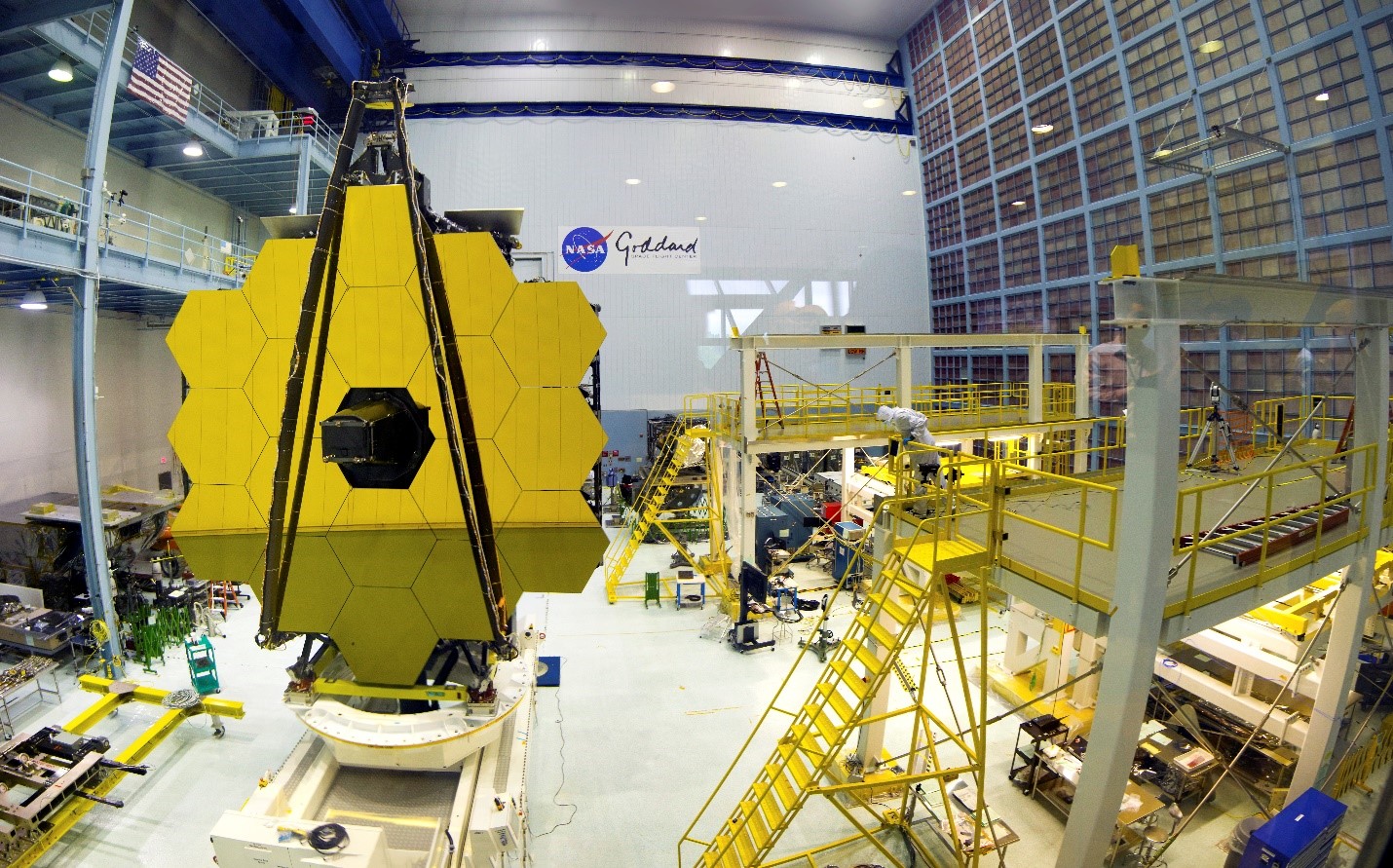
The Integration and Test Branch is responsible for design and hardware development activities that lead to the integration and test activities for spaceflight hardware, science instruments, special payloads, carriers, and spacecraft, as well as conducting functional, performance, and environment tests on these flight systems.
The Branch provides manufacturing and fabrication support for developing state-of-the-art science instruments, spacecraft systems, components, and devices. The Branch provides quick reaction design, development, fabrication, assembly, integration, and modification of science experiments and instruments for ground-based aircraft, balloon, space flight, and laboratory research. The branch supports advanced hardware development by evaluating, investigating, and resolving manufacturing difficulties resulting from process, design, and/or material deficiencies. Provides design review services regarding the producibility and practicality for fabrication of advanced instrument and sensor designs and spacecraft components. Also provides metrology consulting services. Provides the links between mechanical design and rapid prototyping equipment. Provides conceptual and detailed mechanical design support for the development of flight systems and ground support equipment. Teams with scientists and engineers to conceive piece part designs that will meet scientific performance goals.
Components and/or subsystems are then received by the Branch after completion of component/subsystem level verification programs for integration into the system. The Branch is responsible for engineering, management, planning, development, and implementation of environmental tests and test programs for spacecraft, instruments, and subsystems per requirements specified in project verification plans or established by the project customer. Responsible for acquisition, management, upgrade, and operation of the integration and environmental test capabilities.
Responsible for advancing and improving environmental test techniques, facilities, processes, and approaches. Develops requirements and manages studies and analyses to advance test methods and techniques. Provides integration and environmental test expertise for assisting in planning, managing, assessing, procuring, and troubleshooting integration and test activities.
The Branch develops and sustains a cadre of Integration and Test (I&T) managers to plan and coordinate I&T activities for the flight system. The Branch develops and maintains a cadre of Test Conductors (TCs) to perform tests on the various components and subsystems that are integrated to the flight system. The Branch develops and maintains a cadre of technicians to support integration and de-integration of components, as required. Provides engineering and technician expertise, facilities, instrumentation, and technical support for the structural and mechanical integration, test, handling, and launch of spacecraft structures, mechanisms, experiments, and spacecraft. Provides the technical interface to customers for planning, coordinating, and executing mechanical integration.
The Branch works closely with flight project management, flight components/subsystems developers, ground system developers, and test facility operators to ensure that the test activities are consistent with the built components and subsystems, as well as the function or performance to be verified. Branch personnel are also responsible for payload operations at the launch site during integration and test of the space flight system payload with the launch vehicle. The Branch provides I&T expertise support to the flight project during flight system development, pre-launch site I&T, shipment and launch site I&T, launch and post-launch operations.